
The geography of disenchantment: In search of the meaning of life
By Priyanka Lugani
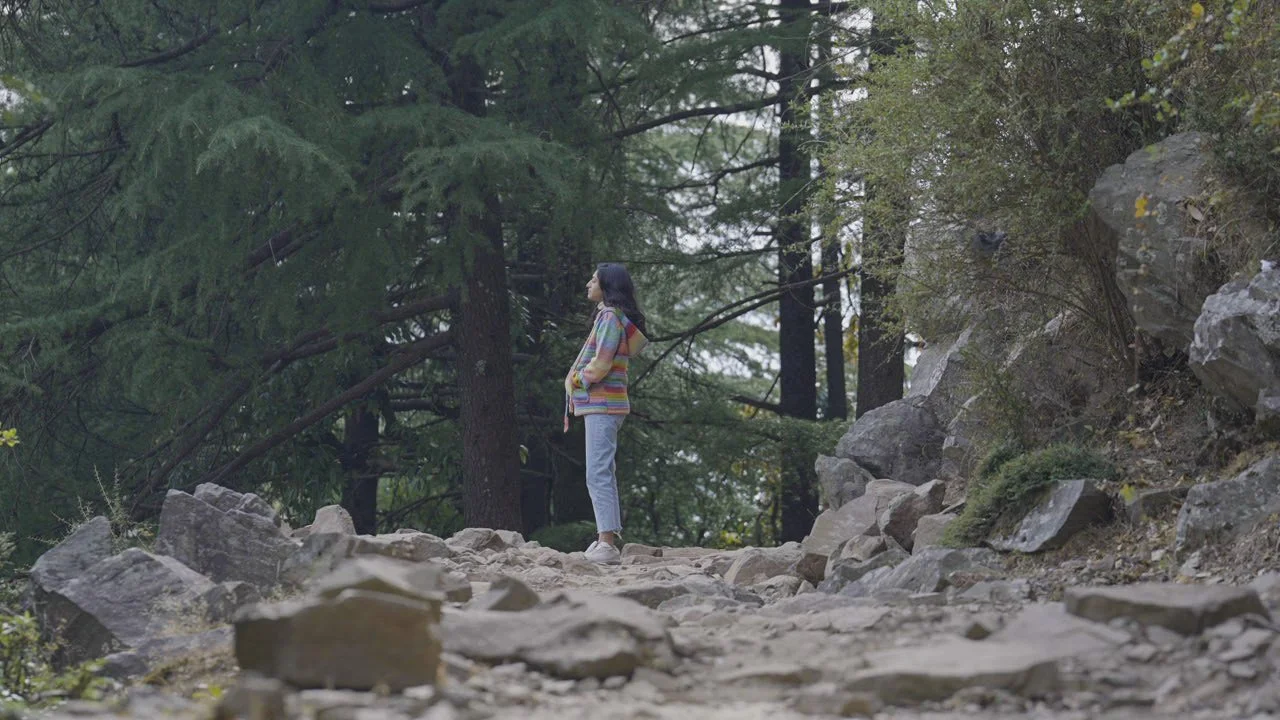
I recently returned from the mountains of Dharamshala. Beautiful… the pine trees, crisp air, and snow-capped peaks.
Many of us travel to these heights when we are disenchanted, questioning the meaning of life after our personal illusions have collapsed.What is it about the mountains that calls to us in these moments? I have often felt we go there seeking silence, but what we often find is a confrontation with the fantasies we’ve lived inside for years.
Is it the distance—secluded far away from our personal dramas—or is it their sheer, indifferent beauty? For sure, something in me becomes quiet. The mind that was full of noise, fantasy, hope, and heartbreak suddenly has to confront something larger than itself.
Disenchantment leaves us in a state of profound pain, and that pain, in turn, makes us seek a way out.
Disenchantment and the meaning of life: Where it leads us
Disenchantment drives people toward monasteries, forests, deserts, oceans, and mountains. Toward places that do not flatter us. Toward places that do not collaborate with fantasy. Toward places that seem capable of holding pain without trying to fix it.
For me, this search for the meaning of life led to years of wandering. I traveled across the world—Peru, Madrid, Turkey, Nepal, and India—moving through cultures, languages, and beliefs in a spiritual journey that was colorful, alive, and intense. Photographs alone could never capture the texture of it. A friend once encouraged me to document those travels, and I began filming a documentary series called The Girl with the Goddess.
I wasn’t just traveling; I was actively searching for something deeper.
See, my disappointment was existential.
I was not only disappointed by a person, a relationship, or a profession. I was disappointed by the collapse of a deeper promise: the promise that life would somehow work out. That suffering would ripen into meaning on its own. That somewhere, perhaps around the next corner, there would be resolution.
That kind of disappointment changes you. It pushes you past ordinary dissatisfaction and into a more dangerous questioning: How do we stop suffering? How do we stop living the same pattern over and over again? How do we step out of what Indian and Buddhist traditions call Samsara and become liberated?
A spiritual journey through India: From Varanasi to Dharamshala
These questions took me again and again through India. From Varanasi and Haridwar to Mysore, Auroville, and Dharamshala, I kept searching. I wasn't a tourist collecting spiritual memories; I was someone trying to understand why human beings remain bound to suffering even when we say we want freedom.
And over time, I began to realize that the crux of it is enchantment.
Hallucinating is so much more fun, isn’t it? Life is great when we are enchanted—you dream, you hope, you imagine. It is a total departure from reality, just like watching Disney when we were kids. We like hallucinating, being fixated on our fantasies. To us, life is an enchanted forest.
The Disney Complex: Why we live inside fantasies
But enchantment is also the psychic atmosphere in which many of us are formed.
As children, we enter a world of stories, images, promises, and emotional dramas, fantasies of love, rescue, union, and transformation. We absorb them before we can evaluate them, and they move into the structure of the psyche. They become templates for what love should feel like, for what fulfillment should look like, and for how suffering should be redeemed. We wait for that one person who will finally arrive and make life whole, searching for the meaning of life through these inherited stories.
By adulthood, many of us are no longer merely enjoying stories; we are living inside them. I sometimes call this the Disney Complex. By that, I do not mean Disney as a corporation or a genre of film, but a structure of expectation, a salvational fantasy. It is the belief that love will transform chaos into harmony, that intensity is a sign of destiny, and that if we endure, love, suffer, or rescue enough, some final scene of completion will arrive.
We organize our adult lives around these archetypes: the knight in shining armor, the wounded beloved who becomes whole through our devotion, or the magical resolution after chaos. We hold onto the promise that emotional sincerity will inevitably produce truth. And yet, while many of us laugh at these ideas as adults, we continue to seek the meaning of life within them, organizing our entire reality around these subconscious scripts.
The Beauty and the Beast: A dangerous fantasy
Take The Beauty and the Beast, for example. At one level, it is a children’s story. At another, it is implanting a profoundly dangerous fantasy: that a frightening, wounded, and chaotic being can be transformed into nobility by love, patience, and sacrifice. Many adult relationships still move inside this logic, attached to distortion because we believe endurance will eventually produce redemption.
In this state of enchantment, we lose our way. We mistake volatility for depth, attachment for devotion, and the burden of emotional labor for the path of love. We cling to the fantasy because we haven't yet learned how to find the meaning of life in reality itself.
Understanding Samsara and the cycle of repetition
This is where enchantment becomes costly. It does not only make life beautiful; it also makes suffering repetitive. And this, I think, is very close to what the traditions of India and Buddhism are pointing toward when they speak of Samsara.
While Samsara is often translated as the cycle of birth and death, psychologically, it is the cycle of unconscious repetition. My teacher in Dharamshala, Rinpoche, describes Samsara as sitting in a prison cell with the door wide open, yet refusing to leave.
Why would anyone do that? Why would we stay in a place that limits our search for the meaning of life?
We stay because the familiar has power. Because identity forms around repetition. Because illusion can feel safer than freedom. And because, so often, the known pain feels more bearable than an unknown life. In this cycle, we mistake the walls of our cage for the boundaries of our existence.
The Architecture of the Psyche: How patterns are formed
This is why liberation is so difficult: we do not merely suffer; we become attached to the very structures through which we suffer. Many of those structures are laid down early. Our childhoods matter enormously because the psyche is not shaped only by major events. It is shaped by atmosphere—by what we see, hear, touch, smell, fear, admire, and imagine.
The child does not simply watch stories; the child uses stories to organize reality. By what love felt like, what tension felt like, or what absence taught us, we build a map for our future.
Later, as adults, we continue seeking under more sophisticated names what was first installed in the psyche in simpler forms: rescue becomes romance, fusion becomes spirituality, and control becomes care. We call this repetition "destiny," often mistaking it for our true search for the meaning of life.
And then, life disappoints us. It disappoints us because reality does not submit to fantasy.
I want to say this carefully: Disenchantment is painful because it is not merely the loss of an idea; it is the collapse of a psychic structure. It is the moment when projection weakens and the fantasy that organized your desire no longer holds. That feels devastating, like a death of the self.
But this collapse is also, potentially, the beginning of humility. Because what falls away in disenchantment is not only hope—what collapses is false hope.
This distinction matters deeply.
What travel reveals: The illusion of movement
When I travelled, I started noticing that no experience was isolated. The scenery changed. The language changed. The religion changed. The clothing, architecture, and moral codes changed. But beneath these differences, similar human patterns kept appearing.
The longing to be chosen. The fantasy of rescue. The fear of responsibility. The repetition of suffering. The hope that somewhere else, with someone else, under some other system, life will finally become whole. We seek the meaning of life in the distance, only to find the same ghosts.
Travel did not free me from those patterns. It revealed them. And that was one of the hardest lessons of my spiritual journey.
Because wandering can itself become part of enchantment. You keep moving, and movement feels profound. You keep searching, and search itself becomes identity. You call it freedom, but perhaps it is refinement of avoidance. You call it spirituality, but perhaps it is grief still looking for a theatre.
Why the mountains matter when we are disenchanted
At some point, I had to confront a more difficult truth:
No landscape can do the inner work for us.
No sacred city can absolve us of the need to see clearly, and no mountain can dismantle illusion on our behalf.
No teacher, no lover, no culture, and no pilgrimage can complete the work that consciousness itself must undergo.
This, I think, is one of the great heartbreaks of adult life—the realization that the meaning of life cannot be found outside of ourselves.
Perhaps this is why the mountains matter. They do not promise. They do not seduce. They do not interpret your pain for you, and they certainly do not offer a happy ending. They stand there in immense beauty and immense indifference. And in their presence, something false begins to fall away.
Perhaps we seek the mountains when disenchanted because some part of us is ready to stop negotiating with illusion. We are ready to stop asking fantasy to become reality, ready to stop calling repetition "fate," and ready to stop confusing emotional intensity with truth.
Perhaps we go there because some quieter intelligence in us knows that the loss of enchantment is not the end. It is the beginning of seeing reality.
And reality, when faced with enough honesty, becomes a different kind of grace in our search for the meaning of life.
